A flat's worth of decisions. Which pan you fry in, and how much the electricity may cost you before you stop caring where it came from. A poplar in the courtyard comes down, and you either go outside or you stay in. Behind all of it sits a question you have never put into words, about whether the living world holds any claim on you at all.
YOUR COMPASS ON THIS ROUTE
STATION 1 / 12
I would give ten years of my life to see the earth once as it was before us.
Rousseau wanted the earth with the human additions peeled away. His Discourse on Inequality runs an experiment and calls it one: take off property and the comparing eye of the neighbour, then ask what is left of a person. A creature that wants to live and winces when something else suffers, he answers. He conceded that the condition he described may never have existed anywhere on a map, and he kept it anyway, since a measure has to stand outside the thing it measures. Émile is raised away from town on the same principle, learning from a falling stone before he learns from anyone's opinion. Trading ten years for one morning of a world before us is a price he would recognise. The diorama in the museum hall is what remains of his experiment, a river valley built by human hands in order to display a world without them.
Aristotle saw a ladder of purposes where we tend to see a food chain. Acorns feed the pig, and the pig feeds the household. The household in turn exists so that somebody inside it can think. The ladder was drawn from dissection and from field notes at the Lesbos lagoon, where he spent years watching cuttlefish and cataloguing the organs of hundreds of species, so observation is holding it up. A calf's head scratched through a fence and a wrapped parcel of meat in the same hand would have puzzled him only if you called the two a contradiction. Affection for an animal belongs to whoever keeps it well. What the animal is for follows from what it can and cannot do, and no cow deliberates with herself. His most exposed flank is right here, since the same ladder placed some people below others.
plants exist for their sake, and that the other animals exist for the sake of man
Aquinas denied that a hen holds any right against you, and then forbade cruelty to her anyway. His reason runs through the person doing it: practise indifference on a living creature and the practised hand carries the habit into a house with people in it. Around that sits his larger claim, that every creature has a perfection of its own which the Creator intended, so a hen kept from ever walking on grass has been prevented from being what a hen is. Useful things may be used, which is where his natural law begins. Wrecking a thing for no gain falls outside the permission. Paying twice for eggs he would read as a small purchase of order, and he would immediately ask whether the label tells the truth, since a conscience fed on advertising copy trains the same indifference by a slower road.
Descartes took the spider apart in advance. An animal body, on his account, is a mechanism of fluids and strings that runs the way a cathedral clock runs, and a clock keeps better time than any of us while minding none of the hours. His test for a soul was speech, the kind that answers what it was never prepared for. A dog whimpers, a parrot repeats, and neither one picks up the thread of a conversation; that failure he read as an absence. The rolled magazine in the bathroom is exactly the act his physics licenses, and he licensed it knowing the cost, since he also had to say that the yelp under a shoe reports nobody's pain. His correspondents pressed him on this while he was alive. Every time, his answer described the machinery and left aside whether the machinery felt.
it is nature which acts in them according to the disposition of their organs
Schopenhauer read the animal from the inside, because he thought we are given the inside in exactly one case and that case is our own. Under every body he found a blind pressing towards life, the same drive in a dog as in a person, with the difference lying in how much intellect got stacked on top. Compassion follows from that identity directly, with no calculation to perform. A big cat on concrete under a heat lamp is fed and doctored, and the pressing it was built around has nowhere to go; the pacing along the glass is what remains of a hunt. He would grant the keeper's point about survival rates and keep his objection, since the complaint concerns what an enclosure does to a will, and the body was never his subject. He also thought most people prefer the question settled at the level of feed and veterinary care.
Kant reaches the pigeon by a detour. Duties, in his architecture, run between beings able to set themselves ends, so nothing is owed to a bird directly; a child who learns to shrug at a broken wing, though, is picking up a skill that will later be aimed at people. The rescue is therefore commanded, and commanded for the sake of the rescuer. Eight hundred hryvnias handed across a doorway land precisely where the card puts them, on what the child takes from the transaction. Schopenhauer called this ground for mercy revolting, and the reproach has its own force. Kant would answer that a moral law which drifts with how sorry you happen to feel will fail on the morning you feel nothing at all, while a duty owed to your own character still holds that morning.
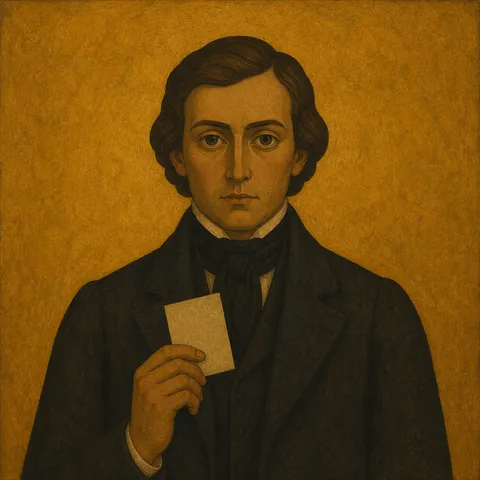
Mill wrote an entire essay to strip the word natural of its authority. Nature, examined as a record of what happens, kills everything that lives, often slowly, and praising her as a standard means praising a process that would be prosecuted if a person ran it. He drew no despair from this. The point of civilisation, in his reading, lies in amending her, from drainage to anaesthesia. The hawk on the fence post with a small bird in its claws is his exhibit, and the jogger stopped on the pavement is watching the argument happen. He stays honest about the cost: once natural settles nothing, every question comes back open and the standard has to be argued out case by case. He took that bill. He also noticed how reliably the word gets produced at the moment somebody wants an argument to stop.
In sober truth, nearly all the things which men are hanged or imprisoned for doing to one another, are nature's every day performances.
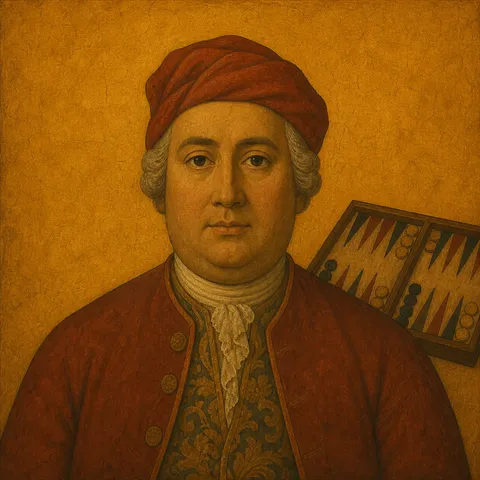
Hume did the arithmetic of the shared bin two and a half centuries before the bin existed. Two neighbours will drain a common meadow, since each sees the other's hand at work and his own share of the gain; a thousand proprietors never manage it, because every one of them hunts for a pretext to leave the trouble to the rest and slip away unnoticed. Nothing in that description calls the thousand wicked. Human passions are built to a human scale, and a benefit stretched across a city is too thin to move them. The bag dropped into the general container beside three empty coloured bins is his case exactly. His remedy is institutional: magistrates and rules reach where sentiment cannot. Tell him your sorting changes nothing and he will agree, then ask who is supposed to collect it.
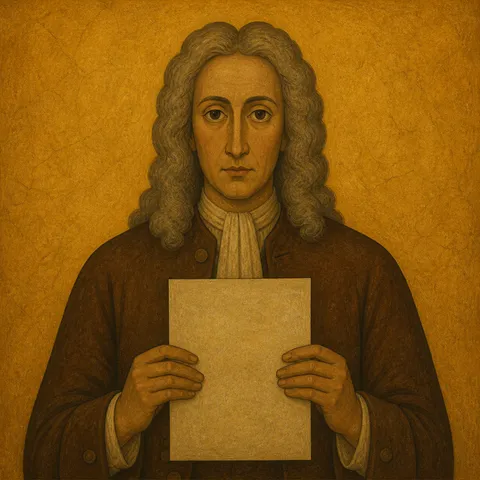
Locke answers the surveyor's stake with a labour theory that keeps a ledger. The earth was given in common, and a man who fences and works ten acres draws more from them than a hundred left wild would yield, so the enclosure adds to the common stock. Property, on this accounting, is earned by the effort that improved the ground, and whoever leaves land uncultivated has wasted what belonged to everyone. Tenancy on behalf of the unborn would strike him as stewardship with the owner left blank, and he held that an unowned field gets nobody's attention in the spring. The limit of his argument is written into the argument: enough, and as good, must be left for others. In a world he pictured as half empty that was easy. The girl beside the stake inherits the version where it is full.
he that incloses land, and has a greater plenty of the conveniencies of life from ten acres, than he could have from an hundred left to nature, may truly be said to give ninety acres to mankind
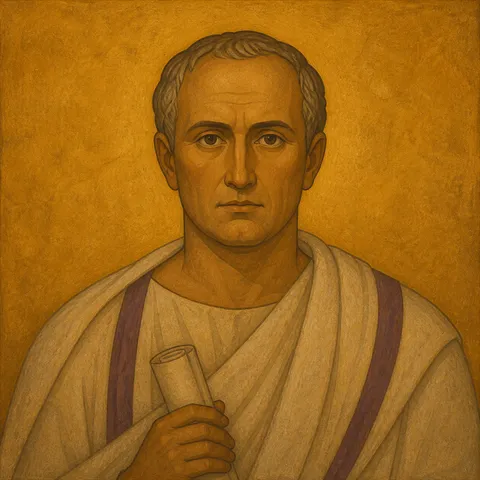
Cicero put the question to a farmer and wrote down the answer. In his book on old age the speaker is Cato, past eighty, listing what the years leave intact, and among the pleasures he keeps are the vine and the orchard: men spend their labour on plantings they know they will never see bear. Asked whom he plants for, the old Sabine names the gods who let him receive the trees from his ancestors and pass them on. Cicero's ground for this lies in his law, one reason shared by every people, tying the living to those before and after them, so a debt can be owed to a person who does not yet exist. The elderly man pressing soil around a sapling in a courtyard is the same scene at the scale of a housing block. Cato owned his land. The pensioner is planting on somebody else's.
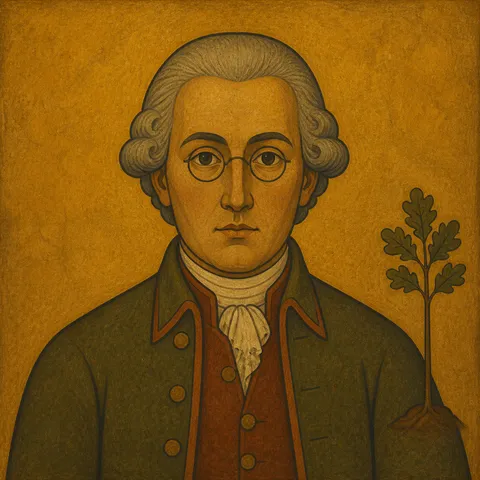
Burke's social contract has three parties and only one of them can speak. The living hold the estate in trust from the dead for the sake of the unborn, which turns a healthy poplar in a courtyard into somebody else's property that you happen to be standing beside. With the man holding the chainsaw he would skip the argument about fluff. He would ask who authorised writing off an asset none of those present ever paid for. His deeper suspicion is about the reasoning itself: a person's private stock of reason is small, and a habit that outlived several generations has been tested by more minds than the single one now holding a clipboard. The woman in slippers between the workers and the trunk is doing what his politics recommends, at the scale where it costs nothing. He knew the same argument shelters arrangements that deserve to fall.
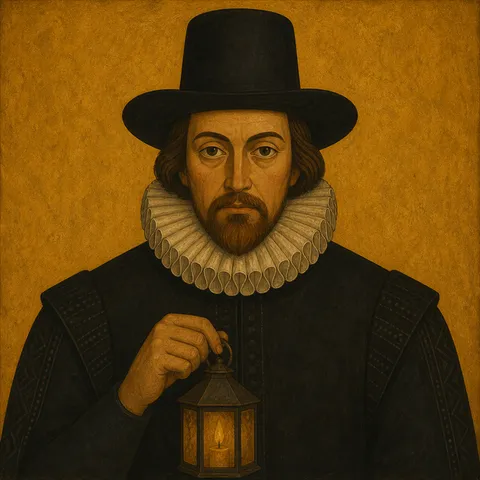
Bacon stated his programme as a bargain: knowing how a thing works is the only way to make it do something else. He ranked the ambition to enlarge man's dominion over the universe above the ambition to enlarge a country's, and he meant it as a moral claim, since relief of the human condition was the whole point. New Atlantis describes institutions producing fruit out of season and animals altered by art, which is a laboratory cutlet four hundred years early. The plated cutlet beside its sealed package is a Baconian object in the plainest sense, made by knowledge of a process, with no animal kept. The question of taste he would push towards trial. What his programme leaves open is the one Lewis later put to it, about who is being altered while the alteration proceeds.
Two questions ran underneath all twelve stations. Does the living world come with an order that makes claims on you, or does it arrive as material with no standing until somebody assigns it some? Your swipes already answered, several times over, mostly without announcing it. If you kept agreeing with the men who look for a purpose inside things, the record on Aquinas shows where that purpose was housed. If you kept siding with the ones who take nature in hand, the record on why the West grew rich shows what that hand built.
SOURCES
Aristotle, Politics, Book I (tr.: Benjamin Jowett; укр. ред.) · en.wikisource.org
René Descartes, Discourse on the Method, Part V (tr.: John Veitch; укр. ред.) · www.gutenberg.org
John Stuart Mill, Nature (Three Essays on Religion) (tr.: укр. ред.) · archive.org
John Locke, Second Treatise of Government, §37 (tr.: укр. ред.) · www.gutenberg.org
Cicero, On Old Age, 24 (tr.: E. S. Shuckburgh; укр. ред.) · www.gutenberg.org
Francis Bacon, Novum Organum, I.129 (tr.: укр. ред.) · www.gutenberg.org
 Jean-Jacques Rousseau
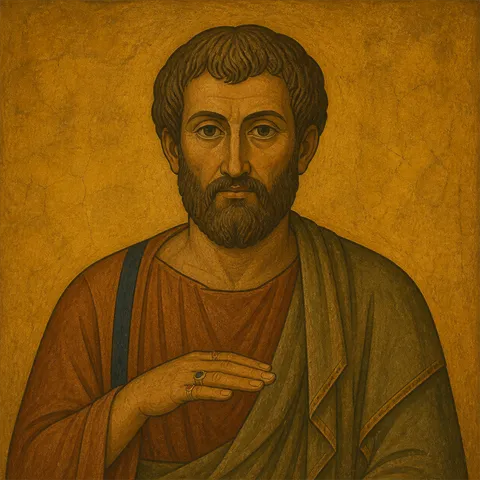 Aristotle
 Thomas Aquinas
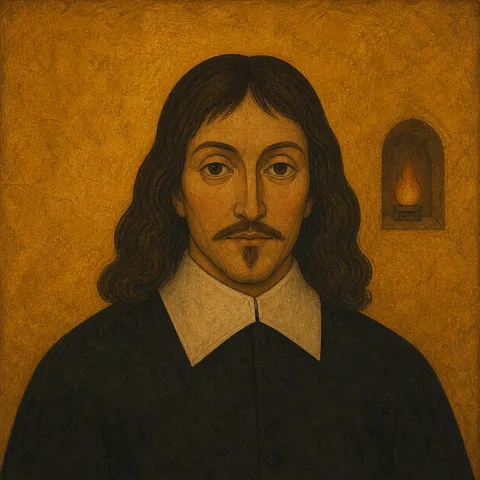 René Descartes
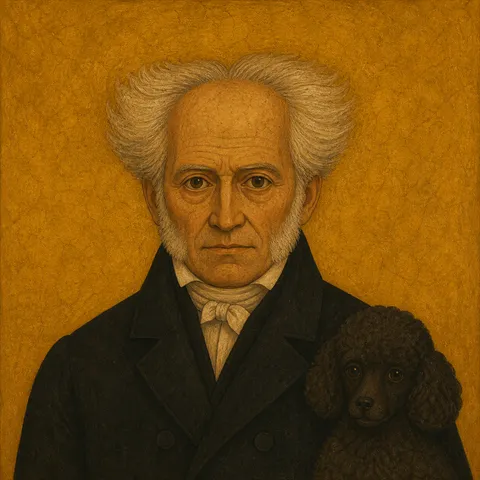 Arthur Schopenhauer
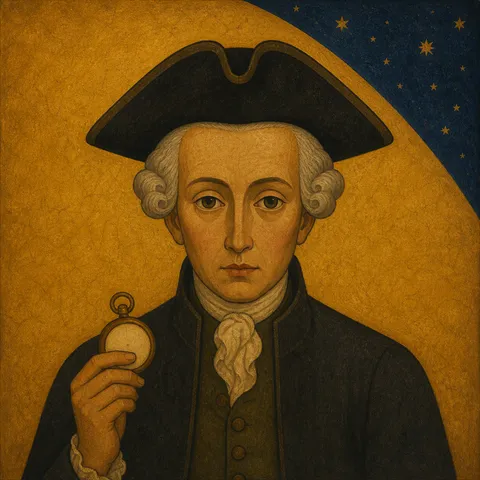 Immanuel Kant
 John Stuart Mill
 David Hume
 John Locke
 Marcus Tullius Cicero
 Edmund Burke
 Francis Bacon