Your mother is calling for the third time tonight. Your father wants to know where every hryvnia of his money went. Somebody expects you to work in the field they paid for. You have swiped all of this already. The old question under the cards: whether the debt to the people who made you comes before your choice, or your choice comes before the debt.
YOUR COMPASS ON THIS ROUTE
STATION 1 / 11
Children owe their parents support in old age even if those parents were cruel to them.
Aristotle begins from the fact that parents gave life and upbringing, and for that reason the account between them and their children never closes. Money gets repaid, a favour is answered with an equal favour, and existence can be answered with nothing. So he puts honour towards parents in the same row as honour towards the gods, and the equality that comes out is of a peculiar kind: the equal man is the one who gives everything he can and still leaves the account open. Friendship between father and son he files among the unequal ones, where the lesser party gives more attention because he received more. The card about cruel parents would get Aristotle's careful attention. In the ninth book he permits breaking off a friendship with someone who has gone incurably bad, and he does it calmly. A father, on the same reckoning, is not abandoned, because the debt stands earlier than the character of the man you owe it to.
Honour too one should give to one's parents as one does to the gods, but not any and every honour.
Cicero wrote On Duties as a long letter to a son who was disappointing him in Athens at that very moment, which is why the book came out so practical. Duties in it stand in an order, and he sets the order down without hesitation: country and the gods first, then parents, then children and household, then the rest of one's fellow citizens. The move that makes the position his is the refusal of an equal love for everybody. The size of an obligation follows from nearness, and a man who stretches it evenly across the world discharges none of them in practice. So taking your parents in at the cost of a marriage stands high on his ladder. He also enters a caution: somebody who abandons the business of the city in order to nurse a household has stepped off a higher rung. His own daughter Tullia he buried, and he never recovered from it.
Paul gives forgiveness a measure, and the measure does not come from the injury. Forgive one another as you were forgiven, he writes to the congregations, which means the account is closed by somebody else's decision and not by your relief. Forgiveness for him is an act, and it does not depend on mood, so an apology arriving after twenty years he would accept earlier than the man waiting for it would. Then comes the place that makes Paul valuable here. He admitted himself that he does the evil he does not want and that the will inside him is split; a man who wrote that about himself knows what it costs to own up after twenty years. He understood the silence about the rest too: fathers are told not to provoke their children, and the obligation in him runs both ways. The dark part is his own. His lines about submission to authority were later applied to every head of a household.
Augustine had exactly the conversation a reader would give a year for. At the port of Ostia, days before Monica died, they stood by a window and talked about what eternal life would be like; he retold that scene with the detail people keep only for what got cut short. Then comes the most honest passage in the book. When she died he held himself in front of others, thinking tears unseemly in a Christian, and afterwards let them go and wrote down his own shame about them. His conclusion is a strange one: he justifies the weeping on the ground that his mother was a living human being, which is what gives love for her a body. Anyone who would trade a year of life for one calm conversation is, on Augustine's terms, bargaining too late. That conversation tends to happen in advance, and at the time it looks like an ordinary evening by a window.
If he finds me to have sinned in weeping for my mother for part of an hour, let him not laugh at me.
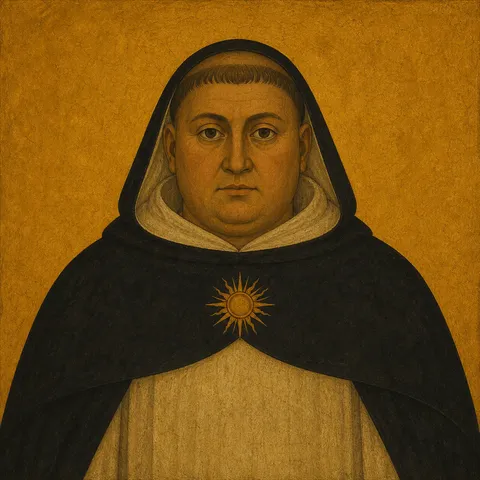
Aquinas takes love to be an ordered thing, and he sets the order out in ranks. The near stand before the far, parents before strangers, and the reason is plain: the good you received from them makes the debt particular, and a particular debt is paid first. The subtlety begins where a family holds two bonds at once. Parents, for Aquinas, are owed the greater reverence, a husband or wife the closer union, and these are different goods that do not compete. So a marriage made without a parental blessing is valid in his hands, and at the same time the debt of reverence stays unpaid; neither of the two cancels the other. Aquinas lived this fork himself. When he decided to join the Dominicans, his family intercepted him on the road and kept him locked up for about a year, until he went anyway.
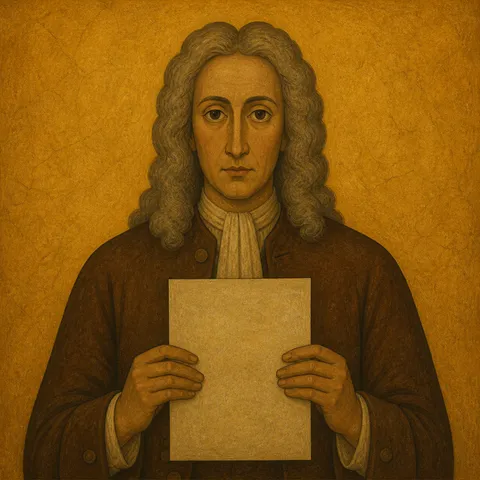
Locke takes parental power apart as a trust with a term on it. A child is born to a state of equality it does not yet stand in; its reason will grow, and then the guardianship loses its ground, because the ground was in the immaturity all along. The comparison he chooses is domestic: the bonds of this subjection are like the swaddling clothes an infant is wrapped in. A father holds authority for as long as he holds the duty to educate, and the two go out together. Hence his answer to the card about turning eighteen, and the answer is narrower than it looks. Obedience ends, while honour and gratitude Locke leaves in place for life, since no date extinguishes them. The same logic he will carry into politics: a power that has stopped serving the people it rules loses its claim on their obedience.
The bonds of this subjection are like the swaddling clothes they are wrapt up in, and supported by, in the weakness of their infancy.
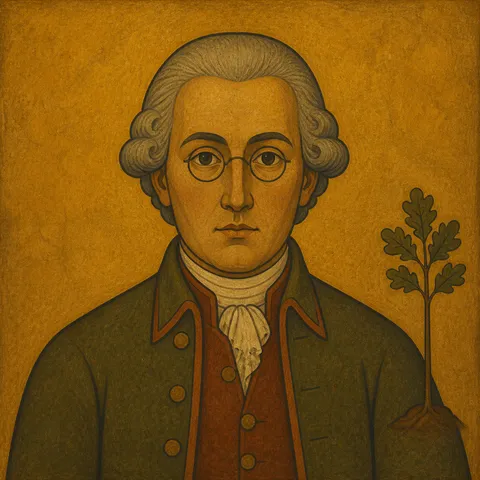
Burke answers 'I chose my own views' with a single question: in what language did you choose them. Inheritance, for him, is no set of opinions to be picked over at a fair; it is the ground a person stands on when the picking begins, with its words and its sense of what is shameful. Hence his defence of prejudice, a word he takes up deliberately: an inherited habit is folded wisdom, and until somebody shows what it was for, it runs cheaper than any theory. Love of humanity, he wrote, begins in attachment to the little platoon one belongs to. Burke was no advocate of every inherited authority all the same. He defended the American colonists against his own parliament and spent seven years pressing for the trial of the ruler of Bengal.
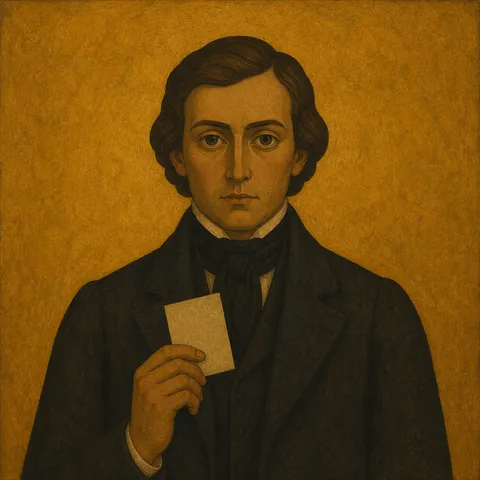
Mill knows this fear from inside, having grown up in it. His father built him a curriculum people later repeated in horror: Greek at three, Latin at eight, logic at twelve, political economy at thirteen. At twenty the machine stopped. He asked himself whether he would be happy if everything he was working for came true tomorrow, answered no, and out of that answer came a collapse that lasted months. The way out arrived through Wordsworth's poetry, which is to say through the one thing his father's programme had left out entirely. The move that makes Mill himself sits right there: he declined to disown his father's method and added to it what the method could not do. Over himself, over his own body and mind, the individual is sovereign, he wrote afterwards, and he had earned that sentence with his own breakdown.
Sartre takes away the last reliable excuse. Existence in him precedes essence: first you are, and only then, act by act, you become what you are, so there is no ready-made nature available to be produced as a cause. An appeal to childhood he called bad faith: a person turns himself into a thing in order to keep his own choice out of his hands. His example came from life. A student came to him torn between a mother who would be left alone and the Resistance, and Sartre refused to supply a rule, because no rule settles that for a man. Then comes the subtlety that usually gets cut out of him. He grants the circumstances completely: hunger, occupation, a father's hand and the language you were raised in all exist. What he denies is that they decide in your place.
Beauvoir wrote a whole book about a girl raised in a respectable family, and the central event of that book is her departure. The house she describes as a situation: a set of expectations in which every step already has a name, and whoever stays inside behaves well at the cost of whatever he might have become. Hence her central claim, carried over from women's lives to any life: nobody is born a person of a given kind, one becomes it, and the situation does more than the nature. So 'I would be a better son further from home' she would read literally: at a distance a son stops performing a role and begins choosing something. She drew no easy resolution out of it. When her mother was dying, Beauvoir sat by her in hospital for weeks and wrote a book about it in which the departure had cancelled nothing.
Skovoroda gave this fork a Ukrainian word. Kindred labour is the work a person was born for, and happiness on his account is possible only inside it; a man driven into work foreign to him will be wretched however well it pays. The test he ran on himself: careers were held out by his relatives and by the empire, from a court choir to a chair, and he turned down each one to spend the rest of his life walking the roads of left-bank Ukraine with a flute and a Bible in his bag. So giving up the profession you dreamed of to keep your parents calm destroys two people at once in his view, because a wretched son pays his debt in a coin worth nothing. One thing here is worth saying soberly. Skovoroda had no children and no sick parents on his hands, and his road cost nobody but himself.
Eleven stations spread along one axis: a debt that stands before any choice against a life that belongs to whoever lives it. Aristotle and Aquinas pull towards the first, Locke and Beauvoir towards the second, Cicero sets out the rungs between them, and Skovoroda changes the question itself, since his measure is vocation. Your swipes have already put you somewhere between those pulls, and it helps to see exactly where. Two doors from here: record 05 on duties set out in ranks, and record 13 on the inheritance you are already standing in.
SOURCES
Aristotle, Nicomachean Ethics (tr.: W. D. Ross) · classics.mit.edu
Augustine, Confessions (tr.: Albert C. Outler) · www.ccel.org
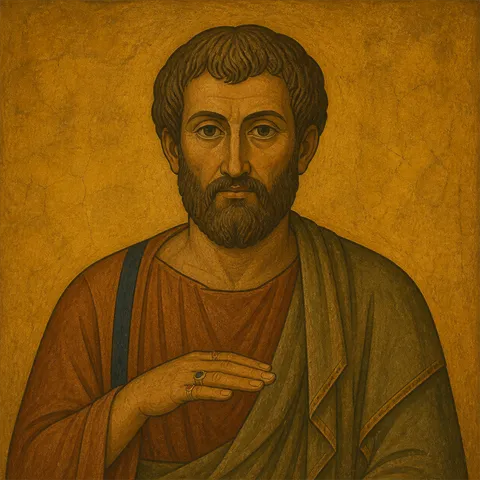 Aristotle
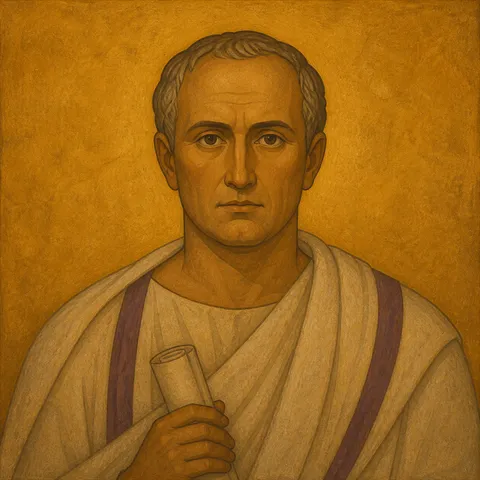 Marcus Tullius Cicero
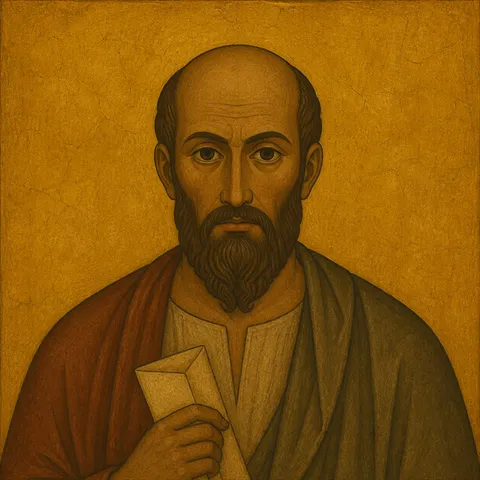 Paul of Tarsus
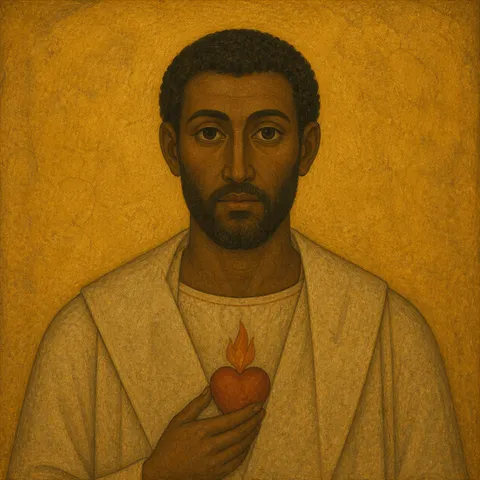 Augustine of Hippo
 Thomas Aquinas
 John Locke
 Edmund Burke
 John Stuart Mill
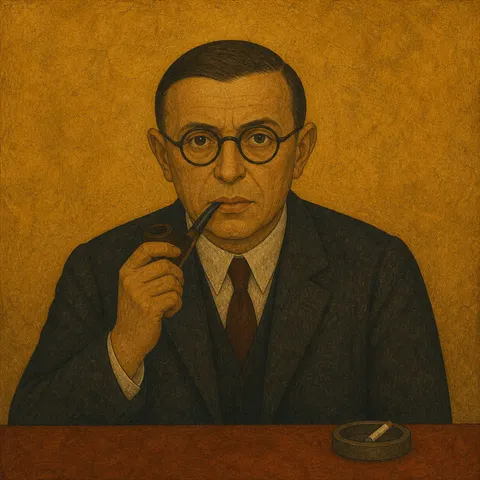 Jean-Paul Sartre
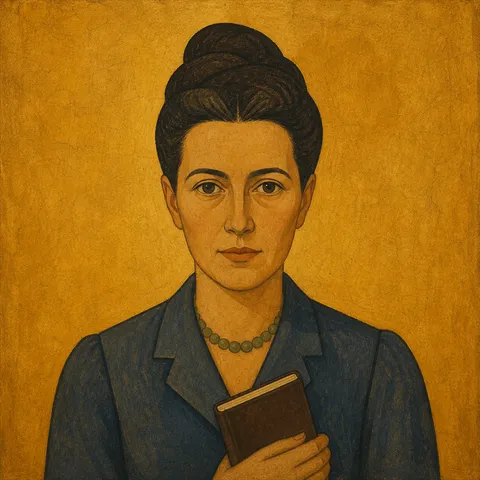 Simone de Beauvoir
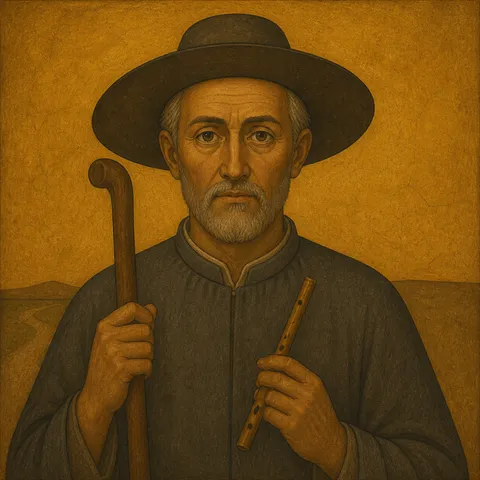 Hryhorii Skovoroda