You carry it every day and remember it when it hurts. Or when it will not fit the frame, or when it has to last until the exams. The question underneath is awkward: do you have a body or are you one. The answer decides who may do things to it and what pain means. Ahead stand twelve people who answered differently and paid for their answers in the flesh.
YOUR COMPASS ON THIS ROUTE
STATION 1 / 12
I treat my body like a device to be repaired before exams.
Plato gave this position its cleanest statement in the Phaedo, a dialogue set on the day his teacher was executed. The body appears there through its obstructions: it brings illness, interrupts thought with needs, fills it with fears, and shows the world through the narrow slits of the senses. A soul that follows the body is pulled into the region of the changeable and begins to wander. Hence his definition of philosophy as a practice of dying, meaning the habit of attending to what the sense organs do not govern. Treating the body as a thing to be repaired before exams is entirely consistent inside that scheme: a craftsman services his instrument so the instrument stops interfering with the playing. Plato would add one correction awkward for the caricatures of him. In the Republic gymnastics stands beside music in a pupil's curriculum, because a body out of tune spoils thinking too.
the soul too is then dragged by the body into the region of the changeable, and wanders and is confused
Aristotle would reject the frame in which the body serves a soul kept separate from it. For him the soul is the form of a living body, the way sight is the form of an eye: they come apart on paper only. Which makes his virtue tangible. Virtue is hexis, a settled make produced by repetition; a person becomes brave by doing brave things and temperate by doing temperate ones, while definitions help nobody here. The morning you do not feel like it is worth more in this scheme than the morning of enthusiasm, since that is the morning that turns a practice into a state. Aristotle would set two limits. One is measure, because excess ruins as surely as lack, and an athlete with a single developed capacity is for him a case of spoiled upbringing. The other is purpose. Your yes at 6:30 he would accept, then ask what you are training for.
Epicurus put a short question to the body: what is it actually asking for. The flesh cries out against hunger and cold; that cry has a limit which bread and a roof close. Whatever is eaten past the limit is addressed to the imagination, and so it never arrives as fullness. He kept a school where supper was bread and cheese on the table counted as a feast, and he wrote to a friend that water and a barley cake give pleasure filled to its very brim. Pleasure he defined through the absence of pain: once the body is not hurting and the mind is quiet, nothing further can be added, and every next dish works on variety alone. Eating without hunger functions in this frame as a signal – anxiety has found an occupation for the hands. Your no here Epicurus would sign.
Paul was writing to Corinth, a port city where this card was daily practice, and his answer rests on two claims. First, the body belongs to a person permanently; Christian hope promises the resurrection of the body itself, which makes contempt for the flesh as much an error, for Paul, as a cult of the flesh. Second, the body was bought, and the owner inside it is someone else. Then he takes a step the modern discussion almost never takes. Out of this he draws a common life: the bodies of people in a community are linked, and what one does alters the body of all. He described himself as an athlete who keeps his own body under discipline daily so as not to be found wanting. Your yes on this card Paul would grasp faster than most, since he lived where a body's solitude was obvious, and that obviousness was his target.
know ye not that your body is the temple of the Holy Ghost which is in you, which ye have of God, and ye are not your own?
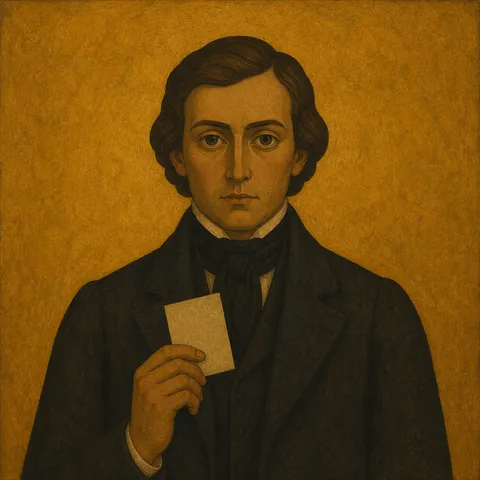
Mill built the most exact defence of this card and attached a single condition to it. The only ground for compulsion is harm to others. A person's own good is never such a ground, and the state has no right to make him happier against his will, however convincing the arguments sound. Then comes his famous line about sovereignty over one's own body and mind. To it Mill adds the argument from experiments in living: different people must try different ways of life, or society will never learn which ones are good, and it settles into the stationariness he went looking for in China. He has a limit too, and it is harder than it looks: selling yourself into slavery he forbade, since freedom spent on abolishing freedom destroys itself. Your yes stands on his ground. The question he left to his heirs is where exactly alone stops.
Over himself, over his own body and mind, the individual is sovereign.
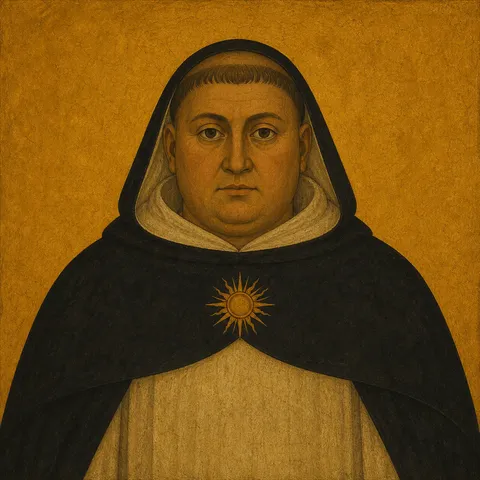
Aquinas treated the body as a part of the person, and it never becomes property in his hands. Hence his rule about part and whole: cutting off a diseased member is permitted when the whole body would otherwise die, because the part exists for the whole. The rule cuts both ways. An intervention that gives the whole nothing is left without a ground, and consent does not manufacture one, since what is at stake is an order of nature that consent cannot rewrite. Then Aquinas opens a place the modern conversation usually skips. Bodily beauty is a genuine good for him, cleanliness and a dignified appearance belong to virtue, and excessive severity toward oneself carries its own name and its own censure. So what he would condemn here is the price: health handed over for appearance. Your no leans on his proportion of part and whole, whether or not you have heard of it.
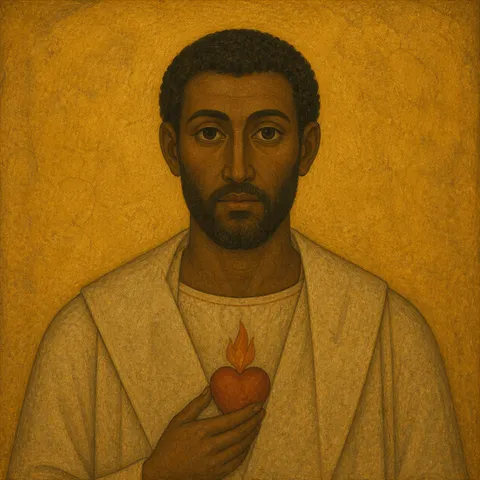
Augustine wrote the most detailed treatment of shame in late antiquity, the fourteenth book of the City of God. Shame carries the force of testimony for him, and he never called it superstition: a person is ashamed precisely of what has slipped out from under the will. In paradise, on his account, the body would obey completely, the way a hand obeys; after the break the will lost part of its own house, and shame records that fact with the accuracy of an instrument. Hence his unexpected conclusion: shame speaks in the body's favour, since it proves that a person was made whole and still remembers it. Augustine had standing here. He lived years he himself described as captivity to habit, and he left his prayer for chastity, with its not yet, in a book for readers. Whoever swiped yes is talking about the shame adults taught; Augustine would separate that from the kind arriving untaught.
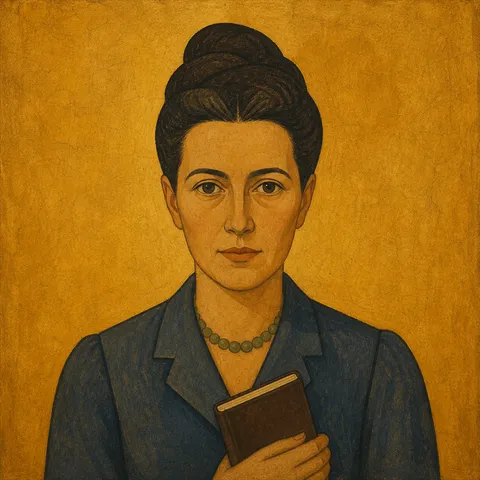
Beauvoir described the body as a situation: along with what it is, the situation includes what another person's look does to it. In The Second Sex she traced how a girl is gradually taught to see herself through a spectator's eyes: she learns early that she is being looked at, and starts living in two registers, as the one who acts and as the one being appraised. A photograph brings that doubleness to its pure form, because in a photograph you see yourself exactly as a third party sees you, and you see it without the movement that usually rescues you. Beauvoir offered no cure by way of self-love. Her move is different: call the situation a situation, something historical, made by people, and therefore alterable. Your yes on this card she would read as a typical experience, set down across two hundred pages long before you.
In the Meditations Descartes looked for whatever survives every doubt and found one thing: while I think, I am. Pain cancels none of it, since pain is itself a thought aware of itself, and the person groaning remains the one who groans. So the card has a plain answer for him: in the worst pain I have gone nowhere. Then comes the place the caricatures of Descartes always hide. In the Sixth Meditation he denies outright that the soul sits in the body as a pilot in a ship; pain and hunger he called proof that the union here is close, intermixed, very nearly one thing. The body signals faster than reason manages to judge, and Descartes admitted it openly. Whoever swiped yes is describing an experience he never disputed. What he would dispute is a single word, the word stop.
Nietzsche inverted the usual hierarchy: the body is a great reason in his hands, and the spirit beside it a small instrument, a plaything of that larger wisdom. Hence his attitude to pain. Illness took his chair at thirty-four, and through the following decade he wrote with attacks that removed his sight for days at a time; out of that came his notion of the great health, the capacity to fall ill and return. Pain works in Nietzsche like a chisel: it cuts away surplus attachments, shows how much a person can carry, puts thought back in its place, and gives the body the first word. Book learning he called cheap for exactly one reason, that it had cost the body nothing. Your yes on this card puts you in his camp, and he would name the entrance fee at once: most pain teaches nothing, and nobody gets to choose the teacher.
Body am I entirely, and nothing more; and soul is only the name of something in the body.
Lewis wrote his book on pain after returning to Christianity and before knowing that widowhood would test the book on him. His argument begins with function. Pain is a signal of damage: a creature without it walks on broken glass and notices nothing until the leg is gone. Then comes the harder part. Pain breaks the illusion of self-sufficiency, and a person who is comfortable almost never asks what he is living for. Lewis called pain a megaphone used on the deaf, and he admitted himself that the argument is terrible. In A Grief Observed he later recorded how prayer went silent and faith cracked, and he kept those pages in. Whoever swiped yes is choosing a world with no signal. Lewis would ask how you find out in that world that something is wrong with you, and who tells you in time.
Marcus Aurelius was ill all his life and governed an empire through a plague that killed millions. His notebook returns to the body calmly and without disgust. He takes his own flesh apart into components: a little blood and bone, matter held on loan and due back. Health in the Stoic scheme belongs among the preferred indifferents: better to have it, and it adds nothing to what a person is. So trading ten years of life for a guarantee strikes him as doubly strange. First, no guarantees are issued, and claiming one is a quarrel with the nature of the whole. Second, the price is quoted in the same commodity you are trying to protect. He would add that illness leaves you everything he counted as his own: the judgement about an event and the action inside it. Whoever swiped yes is counting years without pain.
Twelve stations drew two axes. The body is either an instrument somebody owns or the person you are, whom nobody owns; pain is either a message about damage or a pure evil to be bought off. Look at where your yes cards landed on each axis, and whether it is the same quarter. Two records in the archive grip this map from opposite sides: one is about a last day in prison, where the body is already forfeit, the other about men without chests, whose capacity to feel rightly was taken from them.
SOURCES
Plato, Phaedo (tr. Benjamin Jowett) (tr.: ред. (український переклад цитати)) · classics.mit.edu
Paul of Tarsus, 1 Corinthians 6:19 (King James Version) (tr.: ред. (український переклад цитати)) · en.wikisource.org
John Stuart Mill, On Liberty, ch. I (tr.: ред. (український переклад цитати)) · www.gutenberg.org
Friedrich Nietzsche, Thus Spake Zarathustra, Part One (tr. Thomas Common) (tr.: ред. (український переклад цитати)) · en.wikisource.org
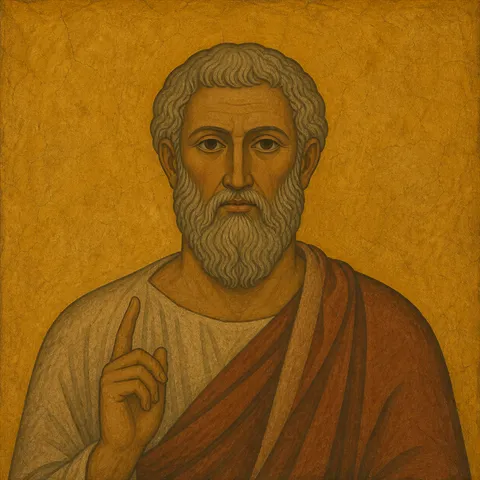 Plato
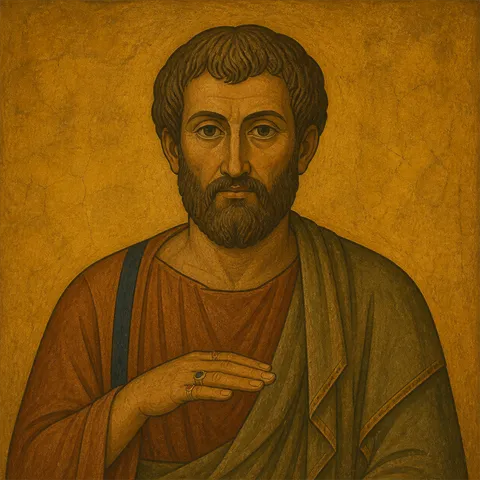 Aristotle
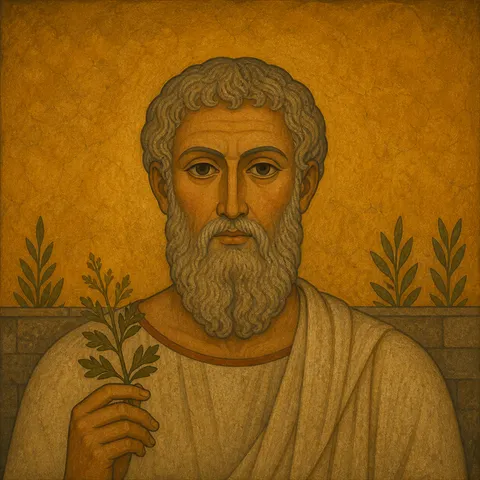 Epicurus
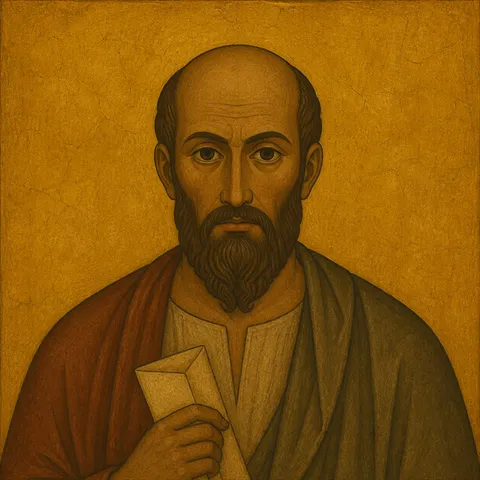 Paul of Tarsus
 John Stuart Mill
 Thomas Aquinas
 Augustine of Hippo
 Simone de Beauvoir
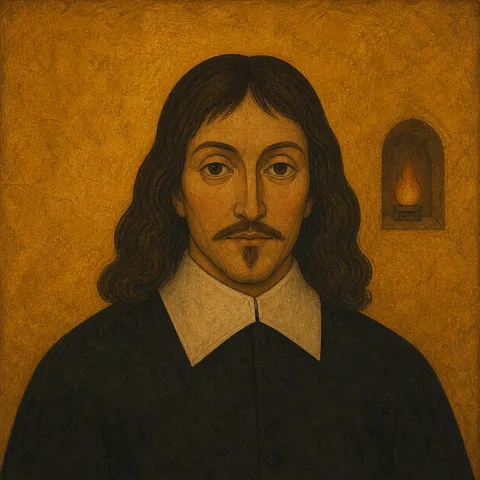 René Descartes
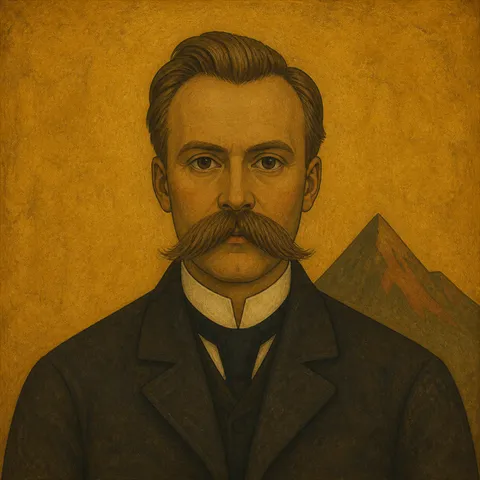 Friedrich Nietzsche
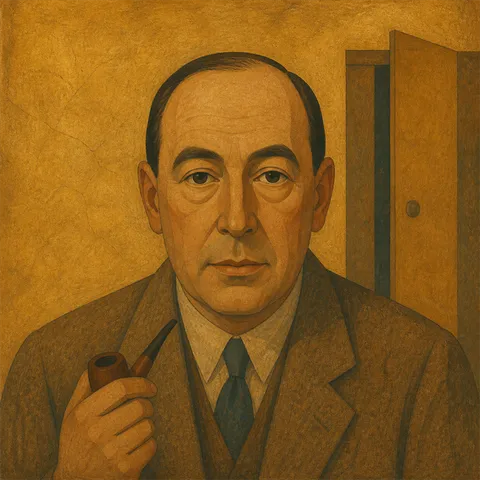 C. S. Lewis
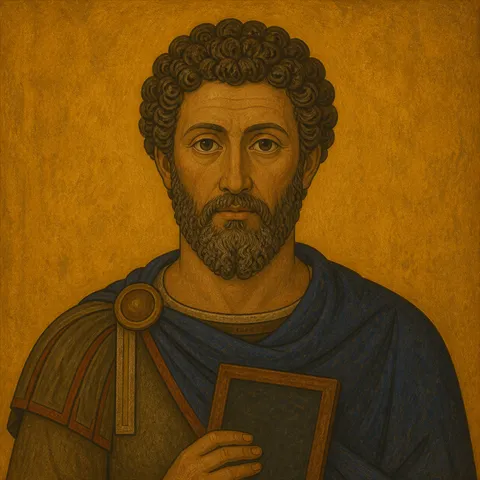 Marcus Aurelius