Something you did is still with you. A person you let down, or a sentence you cannot unsay. You have apologised, or you have decided against it, and either way the memory keeps its own hours. The archive argues about all of it: whether the burning is useful at all, and who is actually owed the telling. Thirty cards later, here is the argument.
YOUR COMPASS ON THIS ROUTE
STATION 1 / 12
I would take the punishment I deserved rather than a quiet pardon.
Socrates measured a wrong by what it does to the person who did it. A soul, on his account, sickens the way a body sickens, and an injustice left standing is that sickness allowed to settle in. In the Gorgias he drives this to a conclusion that embarrasses the room: whoever has done wrong should hurry toward his penalty the way a patient hurries to a surgeon, and the orator who wins him an acquittal does him the real harm. Polus has no answer. Years later, on trial for his life, Socrates declined to propose exile for himself and took what the city handed him. A quiet pardon leaves the thing inside a person untouched, and inside is where he located the damage. You took the sentence you had earned. Socrates would want to know which you were after: a closed account, or your health.
He will run to the judge, as he would to the physician, in order that the disease of injustice may not be rendered chronic and become the incurable cancer of the soul.
Aristotle placed shame among the passions and kept it out of the list of virtues, and his reason is physical. A person caught out blushes; a person facing death goes pale. Both reactions happen in the body, which for him puts shame closer to fear than to any settled state of character. Then comes the distinction that saves the card. In the young he counts it a good sign, since they live by appetite and go wrong often, and the burning holds them back. In a grown man he expects no occasion for it, because a grown man should be doing nothing that calls for it. So the blush is a teacher for a fourteen-year-old and a symptom for his father. Your vote was about a child. Aristotle would take your side and then ask what you plan to do when the child is twenty-five and the shame stops working.
It is defined, at any rate, as a kind of fear of dishonour, and produces an effect similar to that produced by fear of danger; for people who feel disgraced blush, and those who fear death turn pale.
Epicurus built justice out of a compact between people who agreed to stop harming one another, and he measured a breach by what it does to your peace. The evil of a secret wrong, on his account, is the dread trailing after it: you have slipped away ten thousand times and still cannot be sure of the ten thousand and first. Read backwards, that is a strange kind of comfort. Where nobody was hurt in a way they will ever notice, the dread has nothing to fasten on, and a year's pay handed over for an injury the victim never felt goes to settle your own nerves. Epicurus would choose the cheaper repair: say it, and let the debt have an address. You voted against the secret restitution. He voted with you, for a reason you may dislike. He was protecting your sleep.
It is impossible for the person who secretly violates any article of the social compact to feel confident that he will remain undiscovered, even if he has already escaped ten thousand times.
Paul knew the divided will from inside and wrote it down in the seventh chapter of Romans: a man does the thing he hates, wills one way and acts the other, and the chapter ends in a shout for rescue. Anyone reading that page alone would take Paul for the deck's harshest witness on the worst act. The next chapter turns the whole thing over. Condemnation, he says, has been lifted from those who belong to Christ, and the last word about a person now rests with the one who lifted it. He had reason to care. He had held the coats of the men who stoned Stephen, and he retold that in city after city because it made the message credible. Your card says a person is the sum of his worst hour. Paul had lived one, and he would still refuse the arithmetic.
There is therefore now no condemnation to them which are in Christ Jesus.
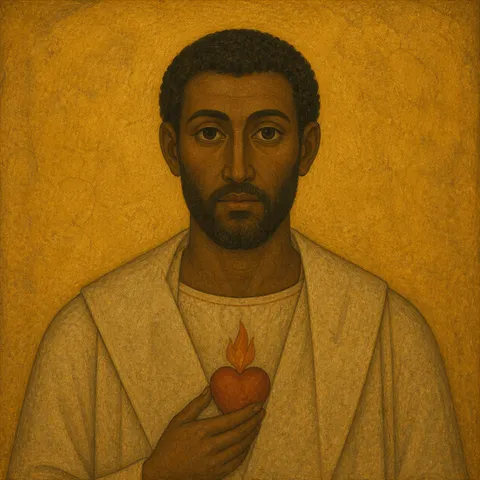
Augustine gave more pages to a childhood theft than to any of his grown sins, and the reason is the missing motive. He had better fruit at home. The pears were poor eating and went to the pigs. What he wanted was the taking, and the company of boys who wanted it with him, and when he looked for anything lovely in the act he found nothing at all. Out of that small shame he built a book people have read for sixteen centuries, addressed to God with the rest of us permitted to listen in. The mechanism is open to view: a shame spoken aloud stops being only yours and becomes a tool somebody else can pick up. You said you would name your most shameful act if it helped anyone. Augustine did exactly that, and he treated the openness as ordinary work that had to be done.
A pear tree there was near our vineyard, laden with fruit, tempting neither for colour nor taste. To shake and rob this, some lewd young fellows of us went, late one night.
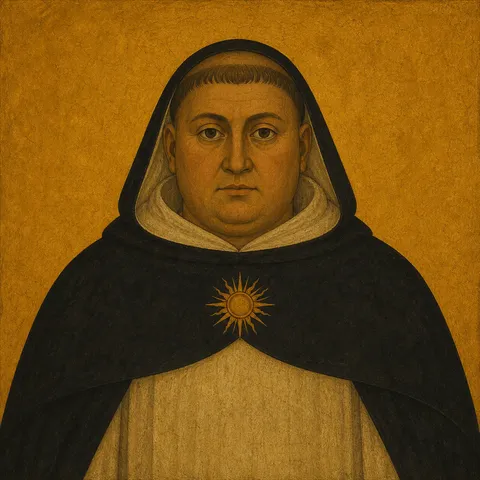
Aquinas treated a good name as a possession, comparable to what a man owns, and detraction as the theft of it. The awkward part is that truth offers no defence. Publishing a real fault without need takes from a person something belonging to him, and an accurate sentence takes it as easily as a lie does. Correction he allowed, on two conditions: it goes to the person's face, and it aims at mending him. A notice in a shop window aims at something else. Restitution, in his scheme, is owed for a stolen name the way it is owed for a stolen coat, which leaves a problem, since a name once circulated cannot be handed back. You voted that nobody may put another's shame on display. Aquinas would add the heavier half: whoever displayed it now carries a debt with no way to pay it.
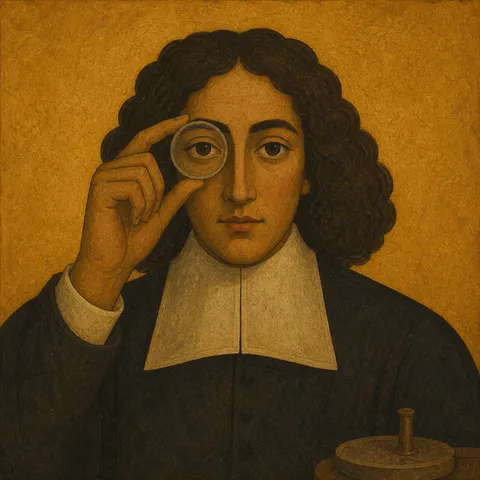
Spinoza worked with a single measure: whatever raises your power to act does you good, and whatever lowers it harms you. Guilt lowers it. That is the whole argument, and it is why the Ethics denies repentance the name of virtue and calls the penitent weak twice over, once for the deed and once for the grief about it. Thirty days of daily guilt come to thirty subtractions from the only faculty that could have repaired anything. His replacement is unsentimental. Understand the chain that produced the act, see why you could not have done otherwise given what you then were, and the sadness loses its grip along with its story. A reader who wants a sterner God will find this cold. You treat daily guilt as a good sign. Spinoza would call it a tax on your own capacity, collected nightly.
He who repents of an action is doubly wretched or infirm.
Smith began from a question about a creature as self-loving as we are: how does it ever reach a verdict against itself? His answer is the borrowed eye. We learn to weigh our own conduct by imagining a fair and well-informed observer watching it, and that observer moves inside and stays. What he says is the verdict that counts, because a court reaches only your property and your body. Shame, on this account, is the sense of being unworthy of love, which is why it stings in places no penalty reaches. Smith saw the weak point too: the spectator inside us is assembled out of the opinions around us, and a corrupt town assembles a corrupt one. You said shame frightens you more than punishment does. Smith heard that as evidence that the spectator is still at his post.
Kierkegaard gave the dead a chapter of their own in Works of Love and called remembering them the most unselfish work love can do, on the ground that a corpse pays nothing back. No gratitude, and no chance that anyone notices. That absence is exactly what he wanted, since it strips out every motive except the love itself. His other commitment stands behind it: guilt is a matter between the single individual and God, and there it carries no statute of limitations, so it can be received as forgiven and can never be quietly filed away. Crossing half a country to a grave is an examination nobody will mark. He would promise you no relief afterwards. You said you would make the journey. Kierkegaard would add that a stone buys nothing back, which is the whole reason to go.
Nietzsche opened the second essay of the Genealogy with a piece of etymology he handled like an excavation: the German word for guilt is the word for debts. Conscience, on that reading, began in the ledger of creditor and debtor, where a man who could not pay put up his own body as security and the creditor collected in pain. Centuries of the training produced an animal able to promise, and able also to turn the collection inward and charge itself. Against it he set forgetting, which he described as a doorkeeper holding the doors of consciousness shut so the house has room for something new. Whoever forgets nothing carries every meal he ever ate. You would trade a year of your life to have one day of yours forgotten. Nietzsche would say you are buying back a debt you invented.
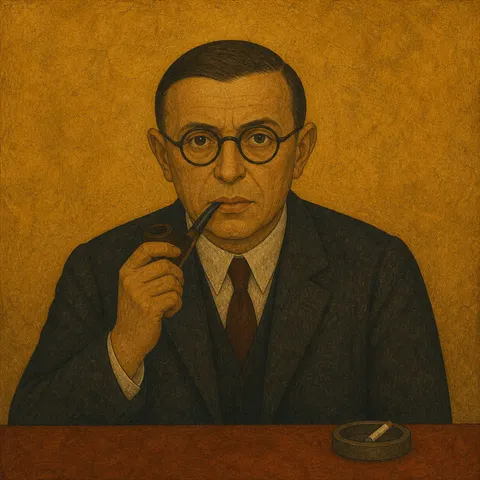
Sartre's case is a man at a keyhole who hears a footstep in the corridor. A second earlier he was pure looking, a project with no outside to it. Now he is a thing in somebody's field of vision, and shame arrives complete, ahead of any question about fault. Shame, on his account, is how I discover that I am also an object for others, and it needs no wrongdoing to get started. That is why it attaches to the name on a passport, or to a queue you happened to be standing in. There is no position from which I can watch myself being watched and correct the picture. You said you feel shame for things you never did. Sartre would decline to call that a defect and would point out that the alternative on offer is invisibility, which was never one of our options.
Lewis noticed that most of what people call forgiveness is a quiet hunt for extenuating circumstances, and that the hunt leaves the real work untouched. Once you have found the reason a man behaved that way, there is nothing left to forgive; you have merely understood him. The Christian demand lands on the remainder, the part with no excuse in it, and Lewis held on to the clause in the Lord's Prayer that makes our own pardon depend on that remainder. He never pretended the arithmetic was comfortable, and he wrote about a man who had injured him for thirty years and whom he managed to release only long afterwards. You said you owe forgiveness to nobody, however sincerely they asked. Lewis would not argue the point. He would ask which of the two of you is still carrying the story around.
Two axes cross in this deck. One runs from guilt as a condition of your soul to guilt as a debt owed to a particular person; the other from shame that trains a child to shame that only marks an adult. Your swipes put you somewhere on both, and the position is worth knowing before the next apology falls due. If your thumb kept siding with the confessors, the record on Augustine shows where the inner court was built. If it kept siding with those who close the account and walk on, begin with Epicurus.
SOURCES
Plato, Gorgias (tr. Benjamin Jowett) (tr.: ред.) · en.wikisource.org
Aristotle, Nicomachean Ethics (tr. W. D. Ross) (tr.: ред.) · classics.mit.edu
Epicurus, Principal Doctrines (tr. Robert Drew Hicks) (tr.: ред.) · en.wikisource.org
Paul of Tarsus, Romans (King James Version) (tr.: ред.) · en.wikisource.org
Augustine of Hippo, Confessions (tr. E. B. Pusey) (tr.: ред.) · www.gutenberg.org
Baruch Spinoza, Ethics (tr. R. H. M. Elwes) (tr.: ред.) · www.gutenberg.org
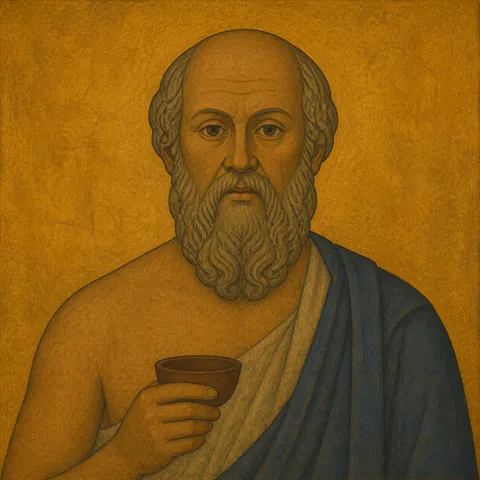 Socrates
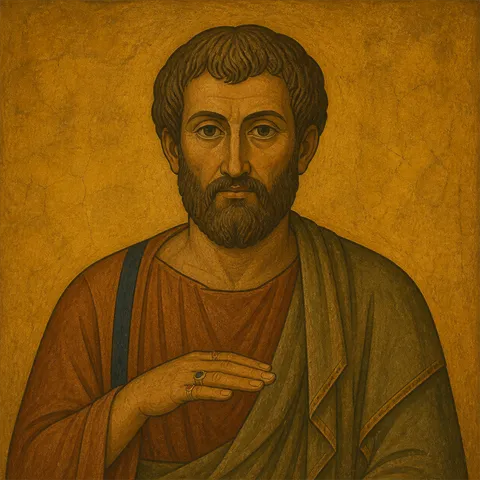 Aristotle
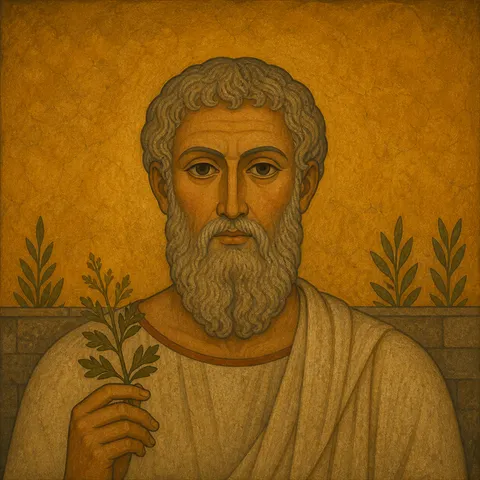 Epicurus
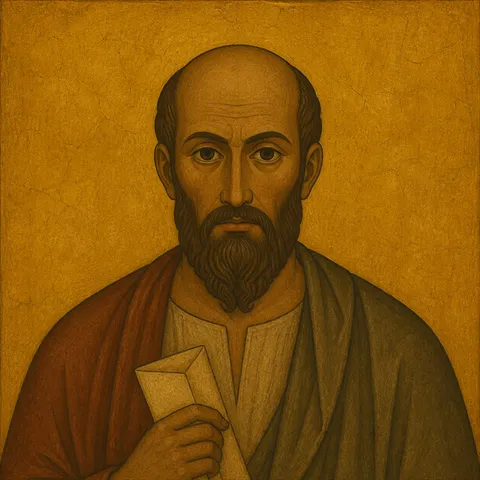 Paul of Tarsus
 Augustine of Hippo
 Thomas Aquinas
 Baruch Spinoza
 Adam Smith
 Søren Kierkegaard
 Friedrich Nietzsche
 Jean-Paul Sartre
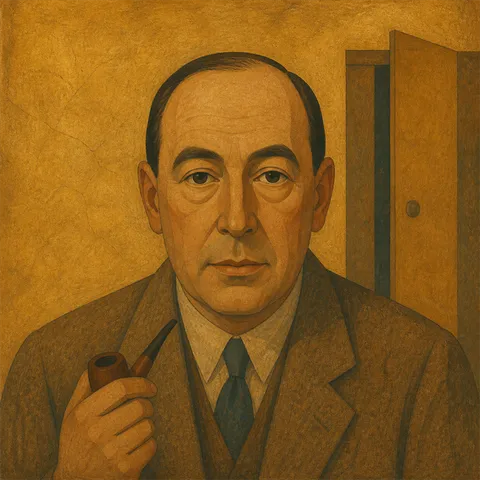 C. S. Lewis